
To play a hand of blackjack, find a table, buy chips, place a wager, receive two cards, and choose to hit, stand, double, split, or surrender when available. Your goal is to beat the dealer without going over 21, not simply to get as close to 21 as possible.
You can win with 18, lose with 20, or stand on a hand that looks uncomfortably low. The right decision depends on your cards, the dealer’s upcard and the table rules.
My advice for anyone learning how to play blackjack: learn the mechanics, find an affordable game that pays 3:2 on blackjack, and use a basic-strategy chart matching its rules. You do not need a betting system or a theory about the player sitting next to you.
Blackjack is gambling. Sound decisions reduce avoidable mistakes; they do not guarantee a winning afternoon.
| Question | Answer |
|---|---|
| Main objective | Beat the dealer without exceeding 21 |
| Best starting hand | An Ace plus any 10-value card |
| Standard blackjack payout | 3:2 |
| Ordinary winning-hand payout | 1:1 |
| Key player decisions | Hit, stand, double, split and sometimes surrender |
| Best first strategy lesson | Use basic strategy and avoid 6:5 tables |
What Is the Object of Blackjack?
You win by having a higher total than the dealer without going over 21, or by staying in when the dealer goes over 21.
Going over 21 is a bust. If you bust, you lose your wager immediately, even if the dealer later busts. You act before the dealer completes the hand, so the order of play matters.
Each player competes separately against the dealer. You are not trying to beat the other players, and their wins do not prevent you from winning.
Wizard of Odds’ blackjack basics explains this distinction and the standard player actions and settlement rules used throughout this guide.
Blackjack Card Values
- Cards 2 through 10: Their printed number.
- Jacks, queens and kings: 10 each.
- Aces: 1 or 11, whichever gives the hand its best total without busting.
Suits do not matter in ordinary blackjack. A king of hearts counts the same as a king of clubs.
Hard Hands vs. Soft Hands
A soft hand has an ace counted as 11. Ace-6 is soft 17. If you take a 9, the ace switches to 1, and your total becomes 16, not 26.
A hard hand has no ace counted as 11. Ten-7 is hard 17. Ace-6-10 is also hard 17 because the ace must count as 1.
A soft hand can take another card without immediately busting. That flexibility does not make hitting always correct, but it explains why soft totals need their own strategy.
What Counts as a Natural Blackjack?
A blackjack, also called a natural, is an ace and a 10-value card in your original two-card hand.
A three-card 21 is not a blackjack. An ace and a 10-value card received after splitting generally count as ordinary 21, not a natural.
A natural ordinarily beats a non-natural 21 and earns the posted blackjack payout. Two naturals ordinarily push, meaning the player’s wager is returned.
Check These Table Rules Before Betting
I would rather spend a minute reading the layout than discover an unfavorable rule after placing a wager. Neighboring tables can have different payouts, limits and playing rules.
- Blackjack payout: Look for 3:2 rather than 6:5 when the other rules and limits are comparable.
- Minimum and maximum bets: Choose an affordable minimum that leaves room for splits and doubles.
- Dealer soft 17: Does the dealer hit or stand on ace-6 and other soft 17s?
- Doubling: Which starting totals may be doubled? Is doubling after splitting allowed?
- Splitting: How many hands may you make, and what restrictions apply to aces?
- Surrender: Is it available, and when?
- Dealer blackjack procedure: Does the dealer check before you act? What happens to additional split and double wagers if the dealer later reveals blackjack?
- Number of decks: Use this when choosing your strategy chart.
If the payout is unclear, ask. The word “blackjack” on a sign does not tell you everything you need to know.
Also check whether the game is a variant. The MGM Grand Detroit gaming handbook describes Spanish 21 as using decks without numbered 10s, while retaining jacks, queens, and kings. That changes the deck itself, not just the payout. Don’t use a standard blackjack strategy chart for that game. The handbook labels its rules illustrative and subject to change, so check the posted rules before playing.
Gamboool’s Comparison: 3:2 vs. 6:5 Blackjack
For this guide, Gamboool assembled selected published rule observations and the supplied payout calculations. This is a comparison of public material, not a representative casino survey or a firsthand table test.
The wagers are illustrative assumptions, not reported casino minimums or actual gambling results. The arithmetic multiplies each assumed wager by the blackjack profit multiplier: 1.5 for 3:2 and 1.2 for 6:5. Results show profit only, excluding the original stake returned on a win.
Gamboool original analysis
We assembled the comparison below from published information and our calculations. These are selected examples, rather than measured gambling sessions or a representative survey.
| Subject | Detail | Published information |
|---|---|---|
| Blackjack Online report on MGM Resorts payout changes | Published historical 6:5-versus-3:2 comparison | The supplied report describes low-limit shoe games paying 6:5 rather than 3:2. Use it as a published payout comparison, not as confirmation of present-day MGM table availability or limits. Source |
| Wizard of Odds blackjack basics | Double, split, and surrender wager mechanics | A full double doubles the wager and permits exactly one further card. Its general explanation describes resplitting usually reaching four hands, unlike Blackjack Live’s two-hand limit. Surrender, where offered, forfeits half the initial wager. Source |
| Wizard of Odds rule-variation reference model | Conditions governing published expected-return comparisons | The rule effects are relative to eight decks, dealer standing on soft 17, doubling on any first two cards, doubling after splitting, and splitting to four hands, with appropriate basic-strategy adjustments. They are not standalone house-edge measurements for a named casino. Source |
| Calculation | Result | Basis |
|---|---|---|
| Illustrative $5 winning natural at 3:2 | 7.5 USD profit (original stake excluded) | Example wager in USD = 5 (assumption); Published 3:2 profit multiplier = 1.5 (illustrative/estimate) |
| Illustrative $5 winning natural at 6:5 | 6 USD profit (original stake excluded) | Example wager in USD = 5 (assumption); Published 6:5 profit multiplier = 1.2 (illustrative/estimate) |
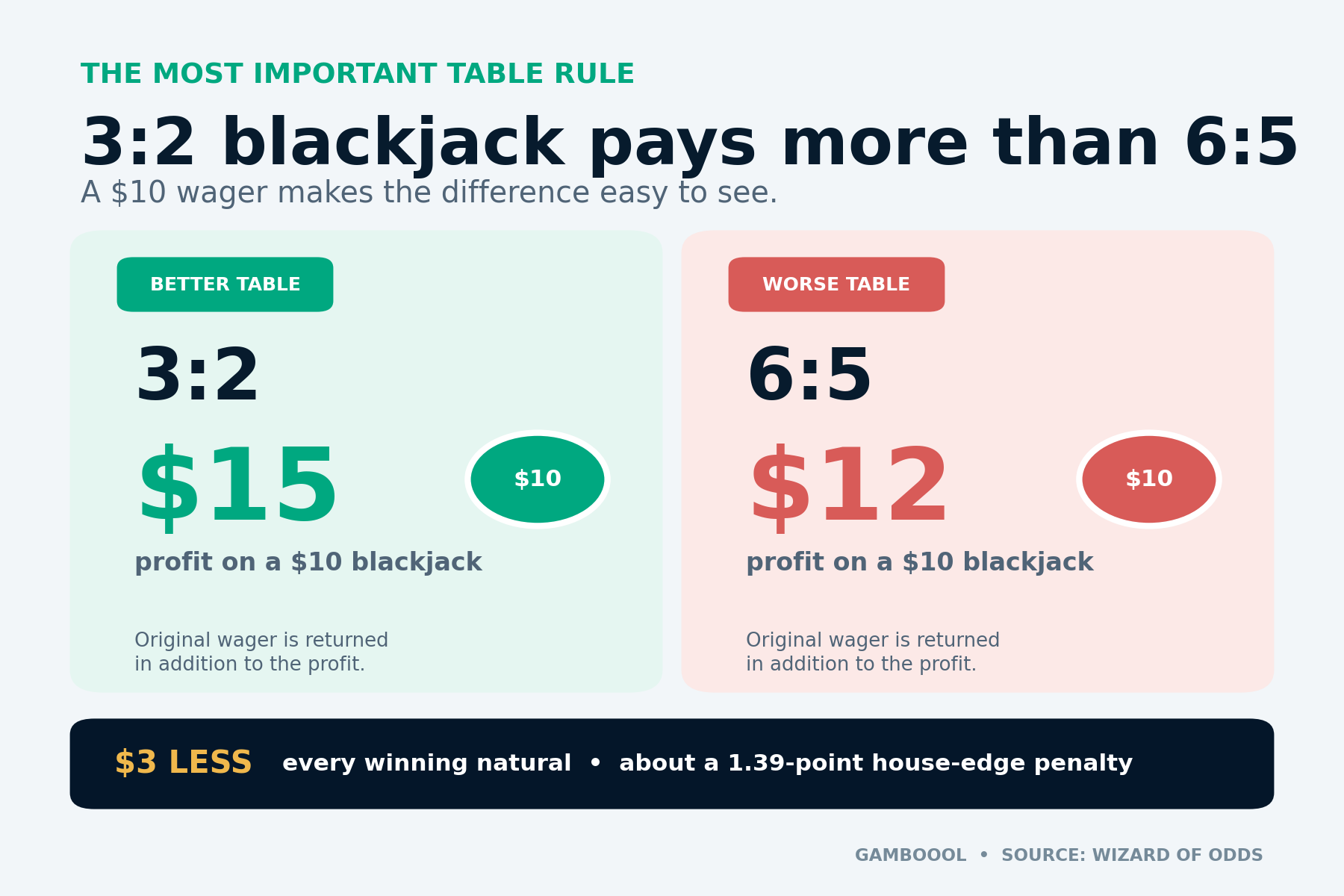
| Illustrative $10 winning natural at 3:2 | 15 USD profit (original stake excluded) | Example wager in USD = 10 (assumption); Published 3:2 profit multiplier = 1.5 (illustrative/estimate) |
| Illustrative $10 winning natural at 6:5 | 12 USD profit (original stake excluded) | Example wager in USD = 10 (assumption); Published 6:5 profit multiplier = 1.2 (illustrative/estimate) |
| Illustrative $25 winning natural at 3:2 | 37.5 USD profit (original stake excluded) | Example wager in USD = 25 (assumption); Published 3:2 profit multiplier = 1.5 (illustrative/estimate) |
| Illustrative $25 winning natural at 6:5 | 30 USD profit (original stake excluded) | Example wager in USD = 25 (assumption); Published 6:5 profit multiplier = 1.2 (illustrative/estimate) |
| Illustrative $100 winning natural at 3:2 | 150 USD profit (original stake excluded) | Example wager in USD = 100 (assumption); Published 3:2 profit multiplier = 1.5 (illustrative/estimate) |
| Illustrative $100 winning natural at 6:5 | 120 USD profit (original stake excluded) | Example wager in USD = 100 (assumption); Published 6:5 profit multiplier = 1.2 (illustrative/estimate) |
Method: Selected published inputs, collected 2026-10-10. Calculations use product. Assumptions are stated in the calculation labels; results are not predictions of a particular session.
A winning natural on an illustrative $10 wager earns $15 at 3:2, compared with $12 at 6:5. Your cards did not change. The posted payout did.
That is why I put the blackjack payout near the top of the shopping list. The same play can yield different payouts for the same winning natural.
Soft 17 Does Not Erase a Short Payout
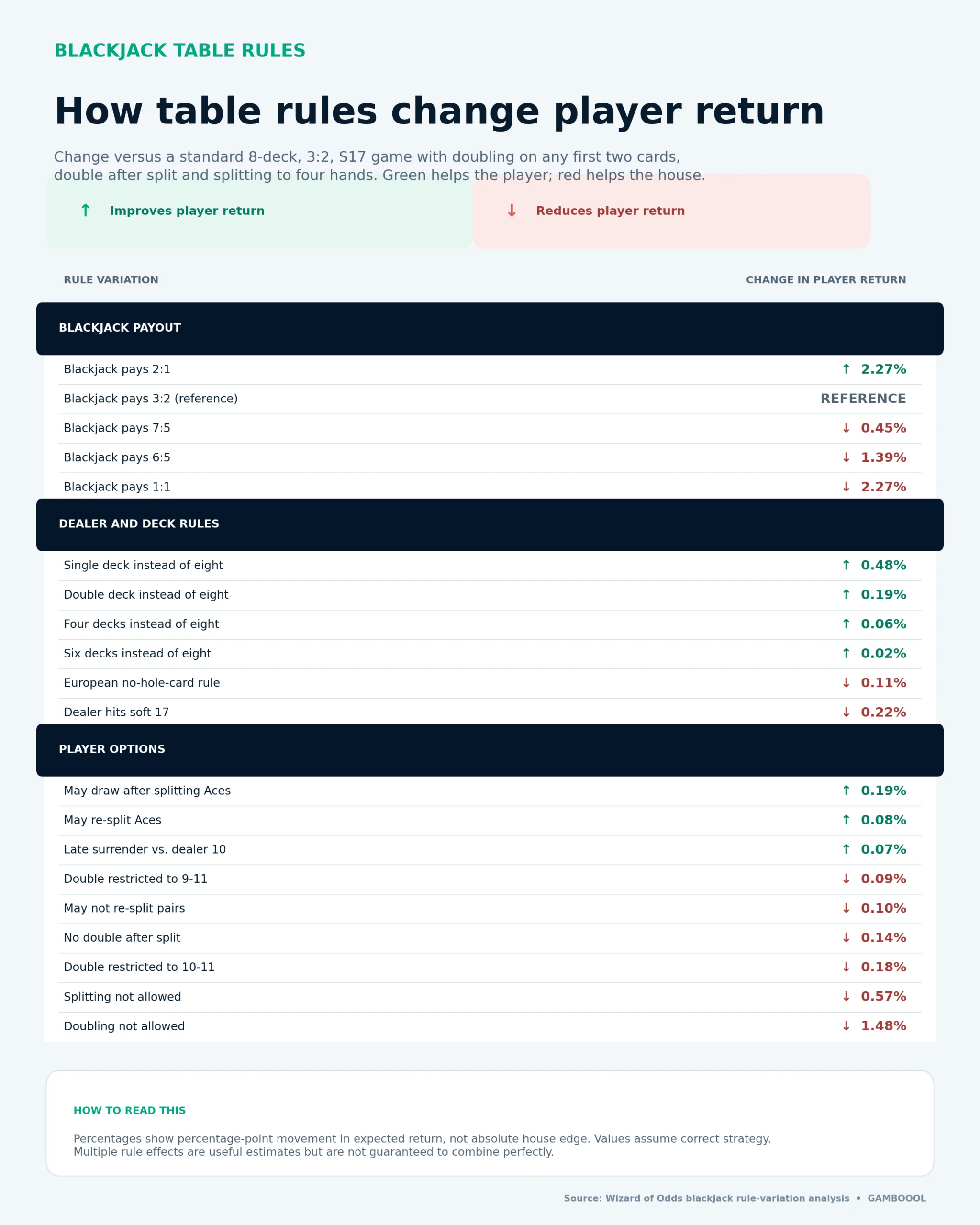
Wizard of Odds’ rule-variation analysis gives useful context. In its reference model, changing blackjack from 3:2 to 6:5 reduces the player’s expected return by 1.39 percentage points. Changing the dealer from standing to hitting on soft 17 reduces the player’s expected return by 0.22 percentage points.
These are published rule effects, not Gamboool calculations or complete house-edge figures for a particular casino. The reference rules are eight decks, dealer standing on soft 17, doubling on any first two cards, doubling after splitting and splitting to four hands, with appropriate basic-strategy adjustments.
Within that comparison, the payout change matters substantially more than the soft 17 change. I would not choose a 6:5 game simply because its dealer stands on soft 17. Read the whole rule package.
Splitting Rules Can Change How You Play
The general Wizard of Odds explanation describes games that usually allow resplitting up to four hands. By contrast, the Blackjack Live rules hosted by the Nevada Gaming Control Board allow a maximum of two hands and no resplitting. That game also stands on all 17s and gives each split ace only one additional card, with no hitting or doubling on those split aces.
These are rules for the named Blackjack Live variant, not universal Nevada blackjack rules. Knowing how to split is only half the preparation. You also need to know what the game permits afterward.
Historical Reports Are Not Current Table Directories
John Mehaffey’s Blackjack Online report about MGM Resorts payout changes describes low-limit shoe games changing from 3:2 to 6:5, along with changes to video blackjack games.
I use that report as published context for the payout comparison, not as confirmation of current MGM table limits or availability. Its property and machine references are not a present-day shopping list. Check the actual table or game rules before betting.
My table-selection order: Find a minimum that fits your budget, check the natural-blackjack payout, then compare soft 17, doubling, splitting, surrender and dealer-blackjack procedures. A better payout is not a reason to gamble at a minimum you cannot comfortably afford.
How to Play a Round of Blackjack
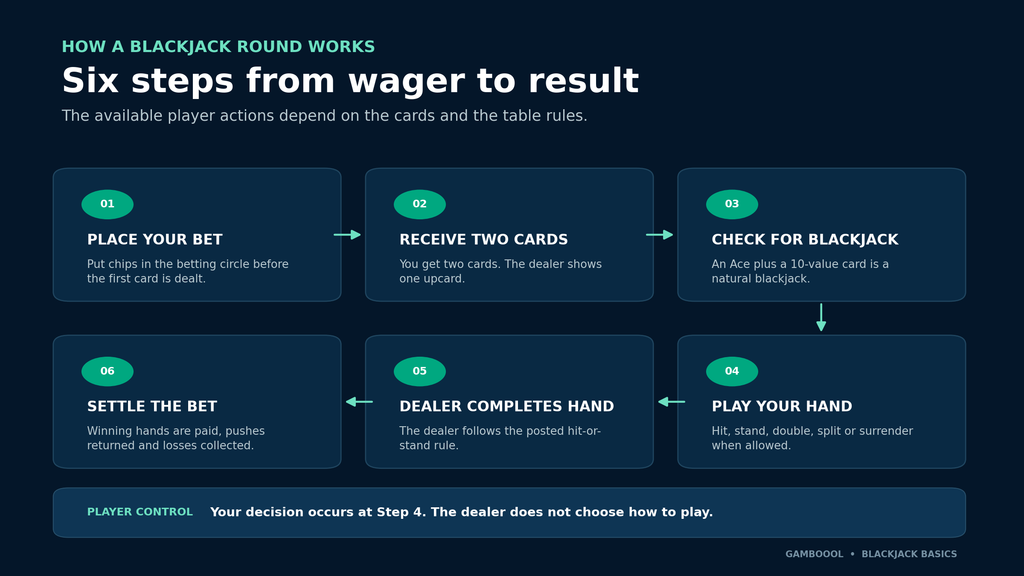
- Place your wager. Put chips in the betting circle before the round begins.
- Receive two cards. In a common casino format, you receive two cards and the dealer receives one face-up card and one face-down card. These are the dealer’s upcard and hole card.
- Resolve the initial blackjack procedure. Depending on the upcard and rules, the dealer may offer insurance or check for blackjack before players act.
- Play your hand. Choose an available action: hit, stand, double, split or surrender.
- The dealer completes the hand. After players finish, the dealer reveals the hole card and draws under fixed rules if a comparison is still needed.
- Settle the wagers. Each surviving player hand is compared with the dealer’s result.
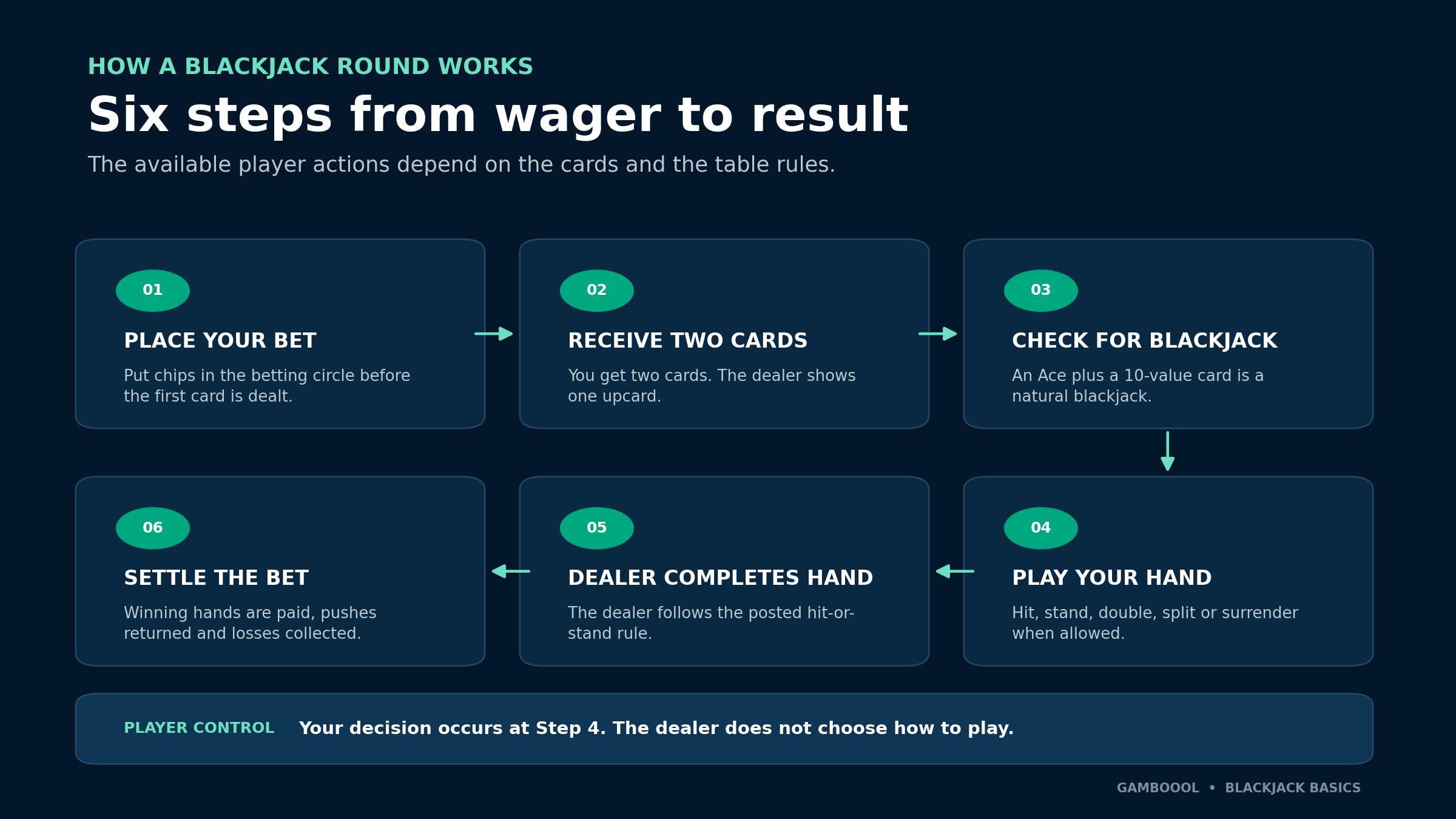
Procedures vary. In a European no-hole-card game, the dealer receives the second card after players act. The treatment of extra split and double wagers against a dealer blackjack varies by format, so do not assume those additional bets are protected.
Your Five Blackjack Actions
| Decision | What it means | When it is available |
|---|---|---|
| Hit | Take another card | Until you stand, bust or reach a stopping condition |
| Stand | Keep your current total and end your turn | On any active hand |
| Double down | Double the wager, receive exactly one more card, then stand | Usually on the first two cards; exact restrictions vary |
| Split | Turn a pair into two separate hands and add a second equal wager | When the first two cards have the same value; house rules vary |
| Surrender | Give up the hand and receive half the original wager back | Only at tables offering surrender, usually before taking another card |
Hit: Take Another Card
Hitting means asking for another card. You can usually continue until you stand, reach 21 or bust.
For example, 7-5 totals 12. A 6 brings it to 18; a king brings it to 22 and busts the hand. The risk of busting does not automatically make hitting a mistake. Sometimes standing has an even worse expected result.
Stand: Keep Your Hand
To stand is to take no more cards. Your total stays put while the other players and dealer finish.
Standing does not necessarily mean your hand is strong. Sometimes the dealer’s upcard makes waiting the better choice.
Double Down: Add a Wager and Take One Card
A full double down adds a wager equal to your original bet. You receive exactly one additional card, and your hand stops.
Doubling isn’t just a bigger bet followed by normal play. You give up the option to keep hitting.
It is normally available on your first two cards. Some games allow doubling on any two-card total; others restrict eligible totals. Doubling after a split may or may not be allowed. Some casinos permit doubling for less, although standard basic strategy generally assumes a full double.
Split: Make Two Hands From a Pair
If your first two cards form an eligible pair, you may split by placing a second wager equal to the first. Each card starts a separate hand.
Splitting 8-8 creates two hands beginning with an 8. The dealer adds a card to each, and you play them under the table’s splitting rules.
Check whether you can resplit, double after splitting, or split different 10-value ranks such as a king and a queen. Aces often have tighter restrictions, including just one additional card per ace.
An ace and a 10-value card on a split hand generally make ordinary 21, without the natural-blackjack bonus.
Surrender: End the Hand and Lose Half
Where offered, surrender lets you end an eligible hand and recover half the original wager. It is normally a first-decision option.
Late surrender, the common version, does not protect you against a dealer blackjack. Early surrender allows surrender before the dealer’s blackjack is resolved and is less commonly offered.
I would not dismiss surrender as admitting defeat. In certain unfavorable situations, losing half is the best available mathematical choice. Your strategy chart tells you when.
Availability can differ within a casino. The Venetian’s gaming guide lists surrender as available only on six-deck shoe games. Ask about your specific table rather than assuming the same options everywhere.
Blackjack Dealer Rules: Hard 17 and Soft 17
The dealer does not study your total and decide whether to take a chance. The dealer follows mandatory drawing rules.
In ordinary blackjack, the dealer hits 16 or less and stands on hard 17 or more. The important exception is soft 17:
- S17: The dealer stands on all 17s, including soft 17.
- H17: The dealer hits soft 17 but stands on hard 17.
With ace-6, an H17 dealer must draw, while an S17 dealer must stand. Other things being equal, standing on soft 17 is more favorable to the player.
Do not copy the dealer’s strategy. You have options the dealer does not, including doubling and splitting, and you lose first if you bust.
Should You Take Insurance or Even Money?
When the dealer shows an ace, you may be offered insurance: a separate wager that the hole card is a 10, giving you blackjack.
Insurance is usually limited to half your original wager and pays 2:1 if it wins. If the dealer does not have blackjack, the insurance bet loses.
Despite the name, insurance does not improve your hand. My advice to beginners following ordinary basic strategy is to decline it.
If you have a natural against a dealer ace at a conventional 3:2 table, you may be offered even money. Accepting locks in profit equal to your original wager, rather than waiting for either a 3:2 win or a push against the dealer’s blackjack.
At a conventional 3:2 table, it is essentially the same financial choice as insuring your blackjack. Ordinary basic strategy generally recommends declining it too. Do not assume the same arrangement applies at a 6:5 table.
Blackjack Payouts: Who Wins and What Gets Paid?
A normal winning hand pays 1:1. A winning natural pays the posted blackjack rate, ideally 3:2. Your original stake is also returned when you win.
A push returns your wager without profit or loss. A losing or busted hand loses the wager. An eligible surrendered hand loses half.
Keep profit separate from the total chips returned. Gamboool’s payout comparison above excludes the returned stake so you can compare like with like.
- You bust: You lose immediately, even if the dealer later busts.
- The dealer busts and you have not: Your unresolved hand wins.
- Your total is higher: You win if neither hand has busted, subject to natural-blackjack rules.
- Your total is lower: You lose.
- The totals match: The hand ordinarily pushes, subject to natural-blackjack rules.
- You both have natural blackjack: The hand ordinarily pushes.
- The dealer has blackjack and you have a non-natural 21: You lose.
- You have blackjack and the dealer has a non-natural 21: Your blackjack ordinarily wins.
A winning doubled hand pays the full doubled wager. Split hands settle separately, so one can win while the other loses.
Beginner Blackjack Strategy
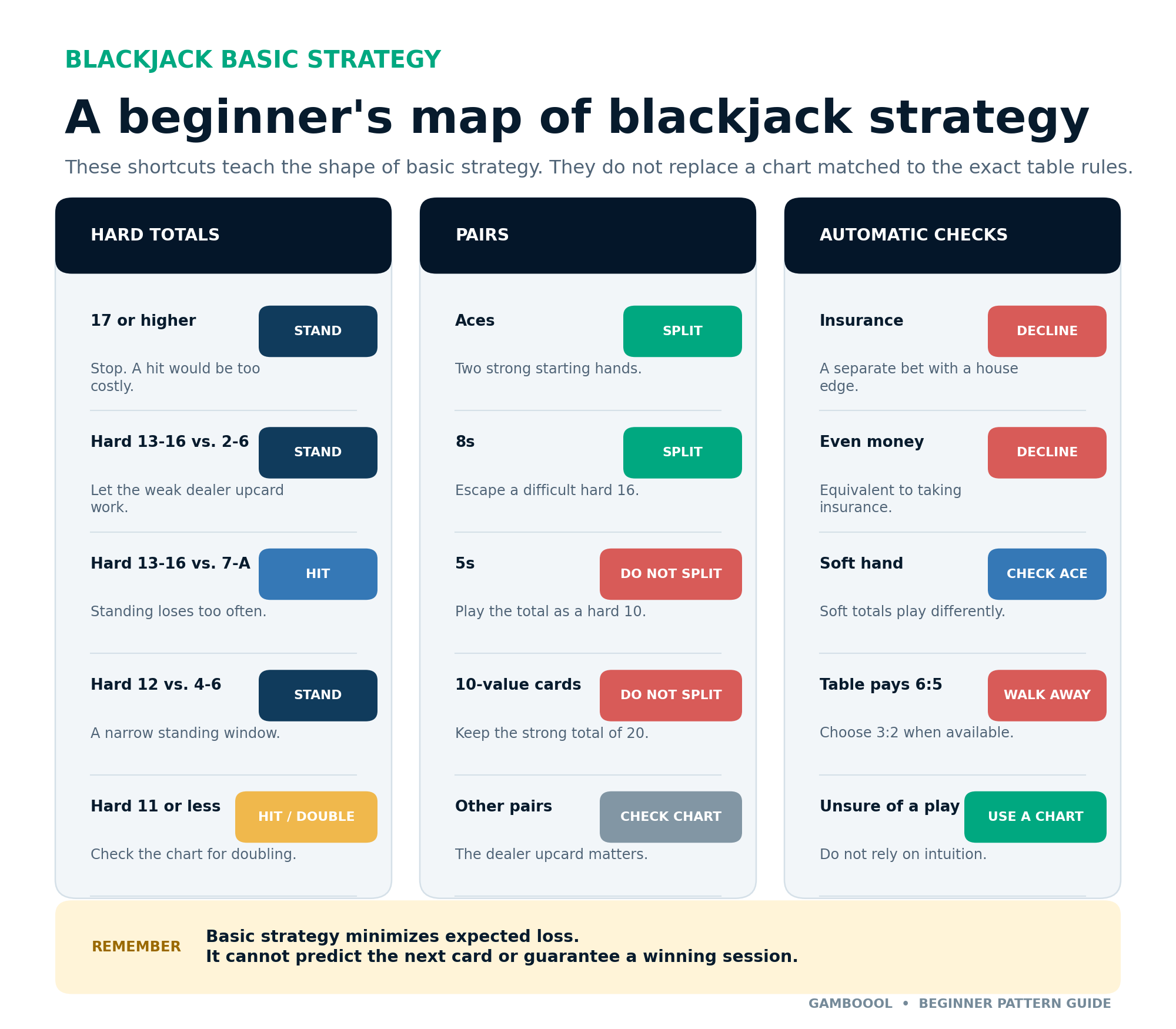
Basic strategy is a mathematically derived set of decisions based on your cards, the dealer’s upcard and the game rules. It aims for the best expected result, not a guaranteed win on the next hand.
I prefer a matching chart to a handful of confident-sounding sayings. Choose one for your deck count, soft 17 rule, doubling restrictions, and surrender options.
These are useful starting points for ordinary casino blackjack, not a complete strategy:
- Stand on hard 17 or higher. Do not automatically apply that rule to soft 17.
- Split aces and 8s as a general beginner guideline, subject to your exact chart and any relevant surrender option.
- Do not split 10-value cards. You already have a strong total of 20.
- Play 5-5 as a total of 10, not a pair to split. The dealer’s card and table rules determine whether you double or hit.
- Decline insurance when using ordinary basic strategy.
- Learn soft totals separately. Soft 18, for example, is not always a stand.
Hard totals from 12 through 16 deserve particular attention. Depending on the dealer’s upcard and rules, standing, hitting, or surrendering can be correct.
Common blackjack mistakes
Sitting at a 6:5 table
This is one of the most expensive mistakes because it applies every time you receive a natural blackjack.
Playing from memory before learning a chart
Blackjack intuition is unreliable. Print or open the correct basic strategy chart if the casino permits it.
Taking insurance
Insurance is a separate side bet with a house advantage for players who aren’t tracking the deck composition.
Refusing to hit a stiff hand
A hand such as hard 15 or 16 is uncomfortable. Sometimes every option is bad, but standing automatically is not the solution.
Increasing bets to recover losses
No betting progression changes the underlying expected value. Chasing losses increases the chance that a normal losing streak becomes unaffordable.
Ignoring the session budget
Basic strategy reduces the house edge. It does not remove variance or make a bankroll unlimited.
Three Ideas I Would Leave Away From the Table
“Never risk busting.” I’ve seen many players who won’t hit on 16 when the dealer shows a 10. Caution is not the same as good strategy. You sometimes need to hit a hand that can bust.
“The other player ruined the hand.” Another player’s unusual decision is not a reason to abandon your chart or blame that person for the outcome. Focus on your cards, the dealer’s upcard and the rules.
Betting Systems Do Not Remove the House Edge
Increasing your wager after a loss does not make the next hand more likely to win. A progression can run into table limits or make a losing stretch much more expensive.
As a beginner, keep bets modest and decisions consistent. Side bets have separate paytables and usually carry a higher house edge than the main blackjack game played with basic strategy.
Casino Etiquette and Bankroll Planning
Tell the Dealer You Are New
Ask how the table handles signals, chips, and cards before your first decision. The dealer can explain the mechanics. For strategy, use your matching chart rather than expecting coaching through every hand.
Use Visible Hand Signals
- Tap or point toward the felt to hit.
- Wave your hand horizontally to stand.
- Place the additional wager beside the original bet and point with one finger to double.
- Place an equal wager beside the original bet and hold up two fingers to split.
At a typical face-up table, tap the felt to hit and wave your hand horizontally over your cards to stand. To double or split, place additional chips beside the original wager and clearly indicate your choice.
Signals differ in face-down games. Ask rather than guess, and don’t rely solely on spoken instructions when the casino expects a visible signal.
Leave Cards and Active Bets Alone
At a face-up table, players generally should not touch the cards. Where holding cards is permitted, follow the casino’s handling rules.
Once the deal starts, leave your original wager alone. Place permitted additional bets, such as a split or double, beside the original stack rather than on top.
Buy Chips Between Hands
Wait for a break in the action, put cash on the felt, and ask for chips. Avoid handing money directly to the dealer.
If you find an open seat during a shoe, ask whether you may join. Some tables allow entry between rounds; others restrict it.
Budget for Splits and Doubles
The minimum bet is not necessarily your maximum exposure for a round. Splitting creates additional wagers, and doubling increases the money at risk.
Choose an entertainment budget you can afford to lose, keep essential money separate, and decide on a time limit before playing. Do not chase losses or borrow to continue.
If gambling becomes difficult to control or stops feeling recreational, stop and seek support. A strategy chart won’t solve a gambling problem.
Frequently Asked Questions About Blackjack
Do I Have to Get 21 to Win?
No. Any non-busted total can win if it beats the dealer’s total or the dealer busts.
Does a Five-Card Hand Automatically Win?
Not in standard blackjack. A five-card automatic-win rule, sometimes called a five-card Charlie, applies only when the game specifically offers it. Drawing several small cards does not necessarily guarantee a win.
What Happens If Everyone Busts?
The busted wagers have already lost. Depending on the game’s procedure, the dealer may not need to finish drawing if no remaining wager requires settlement.
Can I Hit After Doubling Down?
No. Under normal double-down rules, you receive one additional card and your hand ends.
Is Online Blackjack Played the Same Way?
The core card values and decisions are generally the same, but rules vary. Read the help screen for payouts, soft 17, doubling, splitting, and surrender.
Live-dealer games can have decision timers and specific disconnection procedures. The Blackjack Live document above specifies an automatic stand if a player doesn’t act. Learn your game’s procedure before wagering.
Should I Play a Higher-Minimum Table to Get 3:2?
Not if that minimum stretches your budget. A favorable payout does not make an unaffordable wager sensible. Look for another suitable game, practice without money, or skip the session.
Does Another Player’s Decision Change What I Should Do?
Ordinary basic strategy does not tell you to change your decision because another player made an unusual play. Follow the strategy for your hand and the dealer’s upcard.
The Bottom Line
Learning how to play blackjack means understanding card values, choosing your actions, and settling each hand against the dealer. You do not need 21 to win, but you lose immediately if you bust.
My practical advice: shop for an affordable 3:2 game, understand its splitting and doubling restrictions, and use the right basic-strategy chart. Learning the rules is easy. Staying within your budget and making consistent decisions matter just as much.