
Overview: What are fish table casinos?
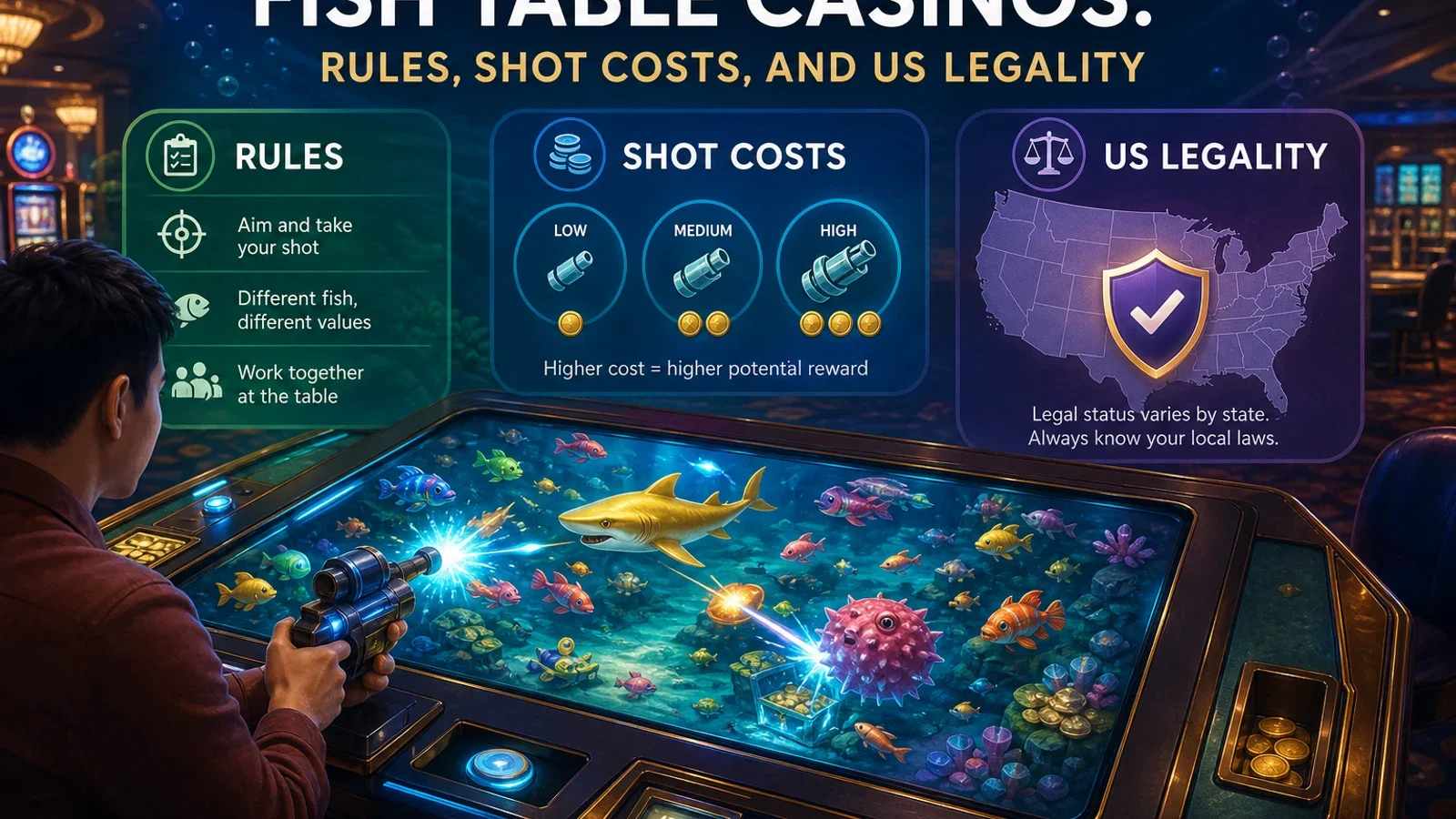
Fish table casinos offer arcade-style games in which players shoot at moving fish, often spending credits on each shot and receiving awards for successful captures. The term can describe a physical gaming venue, an online fish shooter, or a virtual-coin platform. Similar-looking games can have different payment rules and legal status.
My advice is to look past the underwater scenery and ask two questions first: What does firing cost, and what can you actually collect? A colorful cannon and a screen full of prizes tell you neither.
- Check the currency: Cash, entertainment credits, and potentially redeemable promotional coins are not interchangeable.
- Check the charging rules: Each shot may deduct credits, and a bigger cannon may increase that cost.
- Check the capture rules: Hitting a fish does not necessarily trigger a payout.
- Check authorization: Aiming at targets or accepting US registrations does not establish that a product is lawful where you are.
This guide explains the mechanics and the checks worth making before you play. It does not recommend a particular fish table casino or establish that a specific shooter is currently available through a US-regulated operator.
How fish table games work
A traditional fish table is a cabinet with a shared screen and controls for several players. Online versions reproduce the shooting format on a computer or phone, sometimes with multiple players sharing the game area.
Depending on the title, players select a shot value, spend credits to fire, and receive an award when a target is captured. Features may include target locking, rapid fire, upgraded weapons, special creatures, or bonus rounds.
For example, Ocean King’s gameplay instructions describe a Bomb Crab that explodes when captured, potentially earning extra points if the explosion affects other fish. That is a feature of this game, not a rule for every shooter.
A visible hit is not necessarily a successful capture. A game may require several hits, use probability-based captures, or combine player actions with other mechanics. Accurate aim alone does not establish that a shot will pay.
Fish shooters are not fish-themed slots
If the main action is spinning reels and receiving awards under a slot paytable, you are playing a slot, even if the symbols are sharks and fishing rods. A fish shooter involves firing at moving targets. Underwater-themed bingo is another format.
I would choose based on the rules and pace, not the scenery. A pay-per-shot shooter can make spending feel like ordinary arcade action when every trigger pull is another wager.
Practical guide: What to check before playing
1. Identify the product and operator
Determine whether the platform offers conventional real-money gambling, social entertainment, or a sweepstakes-style promotion. Look for a clearly identified operator, eligibility rules, currency explanations, and withdrawal or redemption terms.
If it claims to be a regulated online casino, check your state regulator’s authorized-operator information and match the actual website or app to the authorized brand. A foreign license does not, by itself, authorize online casino gambling in your US state.
For a physical venue, a business license, cash machine, or redemption counter is not proof that the gaming activity is lawful. Physical fish tables can fall under different rules from regulated online casinos.
2. Read the shot, capture, and payout rules
Before spending money, find answers to these questions:
- Does every shot deduct credits, or does one payment buy a round or a set of shots?
- Does changing the cannon increase the cost per shot?
- What distinguishes a hit from a capture?
- Are awards fixed, variable, or expressed as multipliers?
- What amount does a multiplier apply to?
- Who receives the award when several players shoot the same target?
- What happens to paid shots and unfinished features if the connection drops?
If the rules leave these points unclear, ask support. I would rather skip a game than discover its charging rules while the balance is falling.
3. Count shots, not just rounds
In a pay-per-shot game, each trigger action can be a separate wager. A small displayed price says little about what sustained firing will cost. A stronger cannon may also mean a larger deduction each time you fire.
Before enabling automatic fire, locate the stop control and check when firing stops. Watch the cash or credit balance, not just the score, hit counter, or animated coin shower.
Worked example: Bigger cannons and bigger fish
The rules for Crash or Cash’s free Fish Shooter illustrate the distinction between spending, awards, and capture odds. The publisher describes entertainment-only credits with no real-world monetary value, no required deposit or signup, and a free balance refill. This is not a cash casino or a redeemable-prize product.
Its published rules say shots at fish cost credits, taps on empty water are free, and the cannon setting changes the stake rather than the capture probability. These rules apply to this implementation, not every fish shooter.
At the published minimum of 10 virtual credits per shot, an illustrative 100 paid shots would wager 1,000 credits. At an assumed doubled setting of 20 credits, the same shot count would wager 2,000 credits. These figures describe credit turnover, not net losses, cash spending, or an observed play session.
At the illustrative 10-credit stake, a successful capture of a 2x fish awards 20 credits, while a 50x fish awards 500 credits. The publisher’s stated model assigns those targets capture probabilities of 48.5% and 1.94% per shot, respectively, with the same stated theoretical return. These are published-model figures, not independently tested results.
My takeaway: the larger fish offers a larger award, not automatically better value. A bigger cannon can make the balance move faster without improving capture chances. This game’s rules also describe independent shots without accumulated target health, so earlier misses do not make a fish due to pay.
Gamboool original analysis
We assembled the comparison below from published information and our calculations. These are selected examples, rather than measured gambling sessions or a representative survey.
| Detail | Published information |
|---|---|
| Fish Shooter: Product category and credit value | The publisher identifies this example as entertainment-only virtual-credit play, not a real-money casino or redeemable-prize product. |
| Fish Shooter: Deposit, registration, and refill policy | The published rules describe no required deposit or signup and a balance-refill option. |
| Fish Shooter: Minimum shot stake and adjustment controls | The minimum is 10 virtual credits per shot, with controls to halve or double the selected stake. |
| Fish Shooter: Chargeable actions | Shots aimed at fish cost credits, while taps on empty water do not. |
| Fish Shooter: Capture award versus unsuccessful shot | A capture awards the shot stake multiplied by the fish multiplier; a visible shot does not itself establish an award. |
| Fish Shooter: Published probability and payout relationship | The publisher describes lower capture probabilities for higher multipliers while stating the same theoretical return across targets. These are published claims, not independent test results. |
| Fish Shooter: Effect of increasing the cannon stake | According to the publisher, a bigger cannon changes the stake and potential award, not capture probability. |
| Fish Shooter: Previous-shot effects | This implementation explicitly describes independent outcomes without accumulated target health; that rule should not be generalized to every fish shooter. |
| Michigan internet gaming rules: Game authorization and sports-betting distinction | Michigan defines an authorized internet game through a board suitability determination and expressly excludes internet sports betting from that definition. This passage does not establish approval of any particular fish shooter. |
| Michigan internet gaming rules: Peer-to-peer play versus play against the operator | The rules distinguish direct competition between participants, such as poker, from competition against the licensee; a multiplayer screen alone does not identify the financial structure. |
| Michigan internet gaming rules: Meaning of theoretical return to player | Michigan defines RTP as an expected long-run percentage, rather than a promised session outcome. |
| Michigan internet gaming rules: Location restrictions and multijurisdictional limits | The rule requires an authorized wagering location and limits agreement-based out-of-state participation to games authorized under that agreement; it is not blanket permission to access every casino game. |
| Calculation | Result | Takeaway |
|---|---|---|
| Illustrative free-play cost: 100 shots at the minimum cannon setting | 1000 virtual credits wagered | Count every paid shot when budgeting credits; this example measures total wagers, not net losses or cash spending. |
| Illustrative free-play cost: the same shot count at a higher cannon setting | 2000 virtual credits wagered | Compare this with the minimum-setting example: a higher cannon stake increases credit turnover without improving the published capture odds. |
| Free-play capture award: minimum stake on a low-multiplier fish | 20 virtual credits awarded per successful capture | This is the capture award, not net profit after the paid shots used to obtain it, and the credits have no cash value. |
| Free-play capture award: the same stake on a high-multiplier fish | 500 virtual credits awarded per successful capture | The larger award comes with a lower published capture probability; the multiplier alone does not establish better value. |
| Published-model capture probability for a low-multiplier fish | 48.5 percent capture probability per shot under the publisher’s stated model | Use this alongside the low-tier award example to distinguish payout size from capture probability; it is a published model, not an independently tested measurement. |
| Published-model capture probability for a high-multiplier fish | 1.94 percent capture probability per shot under the publisher’s stated model | Compare with the low-multiplier target: a bigger potential award does not imply a better theoretical return or a capture that becomes due after misses. |
Research references: crashorcash.com, ars.apps.lara.state.mi.us.
Method: Published inputs collected 2026-10-14. Illustrative assumptions are labeled, and the full calculation inputs remain in the saved research record. These examples support planning; they do not predict a particular session.
4. Separate awards from profit
A capture award is what the game credits for that event. Your financial result also includes everything spent pursuing it. A large payout animation can accompany a losing session.
| What you see | What it tells you | What it does not establish |
|---|---|---|
| A large target multiplier | The potential award under the rules | The capture chance or whether the target offers better value |
| A stronger cannon | A setting that may change cost or mechanics | Improved capture odds unless the rules say so |
| A rising score | Progress under the scoring system | Net profit or a withdrawable cash balance |
| A shared multiplayer screen | Other players are present | How awards are allocated or whether players compete financially |
| A return-to-player figure | A stated long-run theoretical return | What your next shot or individual session will return |
For multiplier awards, check the amount being multiplied and whether the credited payout includes any return of the wager. Where player decisions affect a published return calculation, its assumptions matter, too.
5. Use practice play to learn the controls
A free mode can help you learn aiming, target locking, weapon selection, and the interface. It cannot prove that paid play will be profitable.
Check whether practice uses the same rules and settings as paid play. Even if it does, a short winning run is not evidence of a dependable strategy. I see practice as a way to avoid interface mistakes, not a preview of future winnings.
6. Check withdrawals, redemptions, and spending limits
Before depositing or buying coins, read the identity requirements, minimum withdrawal or redemption amounts, processing procedures, fees, and prize restrictions.
Keep deposited funds, bonus credits, entertainment coins, and potentially redeemable promotional currency separate in your mind. A large on-screen balance may not all be eligible for withdrawal.
If a promotion is involved, confirm that the shooter qualifies. Games can be excluded, contribute differently toward wagering requirements, or carry special wager limits. The biggest advertised bonus is not necessarily the most useful one.
Set spending and time limits before starting. Do not increase the shot value to recover losses or treat money already spent on a target as a reason to keep firing.
Important qualifications
Are fish table casinos legal in the US?
There is no nationwide rule making every real-money fish table game legal. The answer depends on the jurisdiction, operator, mechanics, payment structure, and prizes.
Online casino authorization is state-specific. Permission to offer one gambling product does not automatically cover another, and an operator’s license does not mean every possible game is approved for its lobby.
For example, Michigan’s internet gaming rules define an authorized game through a Gaming Control Board suitability determination and expressly exclude internet sports betting from that definition. They also define RTP as an expected long-run percentage and impose authorized-location requirements. These provisions do not establish approval of a particular fish shooter.
Physical tables raise separate questions involving gambling law, amusement-device rules, prize redemption, and local enforcement. Calling a machine a skill game does not settle its legal classification.
For a specific product or venue, consult current regulator or government information. Follow the applicable age and physical-location requirements. Do not use false information or location-bypass tools to evade eligibility checks.
Skill does not establish a profitable strategy
Aiming, timing, and target selection may affect play. That does not prove they determine the financial outcome. Capture probabilities, payout settings, random events, and other mechanics can still matter.
I would be skeptical of universal advice to target the biggest fish, select a certain cannon, or wait until someone else has fired repeatedly at a creature. Those suggestions only make sense if the specific rules explain why they would help.
Without rules establishing that previous hits affect capture chances, there is no basis for assuming a fish is nearly finished or due to pay. Better familiarity with the controls does not establish a positive expected return.
Casino games, poker, sports betting, and virtual-coin products
| Product | Key distinction |
|---|---|
| Regulated online casino game | The operator and game must meet the applicable market’s authorization requirements. Availability elsewhere is not enough. |
| Poker | A separate card-game format, commonly involving player-versus-player competition. Poker access does not establish access to other casino games. |
| Sports betting | Wagering on sporting events under its own authorization. A legal sportsbook does not establish that fish-shooting wagers are permitted. |
| Social game | Typically uses entertainment credits without cash redemption. Buying those credits can still cost real money. |
| Sweepstakes-style product | May distinguish ordinary play coins from promotional currency eligible for prizes. Eligibility, entry methods, and redemption conditions require separate attention. |
A sweepstakes label is not blanket permission to participate in every state. Read the official rules, including any no-purchase entry method, location exclusions, and prize conditions. Do not assume every virtual coin can be exchanged for cash.
Licensing and testing have limits
Relevant regulatory oversight and game testing can provide meaningful protections, but neither guarantees profit or eliminates every account dispute. A testing logo alone does not establish coverage of a particular operator and game version.
Random-number generation does not mean every target has the same capture chance or that there is no house advantage. Fair operation means following the applicable rules and standards, not making sure each player wins.
When I would walk away
I would avoid a product that conceals the operator, obscures shot costs, leaves redemption rules unclear, or promises guaranteed income. Be especially cautious about unidentified payment agents or demands for additional money to release supposed winnings.
If play is becoming difficult to control, stop rather than search for a better shooting strategy. Use deposit limits, time-outs, or self-exclusion where available. Do not borrow money to play or count on fish tables to cover bills.
Frequently asked questions
What does “fish table casino” mean?
Usually, it means a venue or platform offering fish-shooting games. It is a descriptive term, not a licensing category, and does not establish whether the product is gambling, amusement play, or a sweepstakes-style offering.
Can you win real money playing fish tables?
Some formats offer cash awards or redeemable prizes; others provide only entertainment credits. Lawful participation and collection depend on the product, your eligibility, and the applicable rules. You can also lose money spent on play.
Does every shot that hits a fish pay?
No. A game can distinguish a hit from a capture, with only specified events triggering awards. Read the capture and payout rules rather than relying on the animation.
Is there a guaranteed fish table strategy?
No. Learning the controls may reduce accidental spending or improve performance in some implementations, but it does not guarantee profit. Secret timing patterns and claims that a fish must pay next are not dependable advice.
Do other players affect your payout?
They may, depending on the rules. A shared screen does not tell you whether awards are independent, go to the player making the final capture, or are allocated another way. Check before paying to pursue a shared target.
Can you play fish tables on a phone?
Some games support mobile browsers or apps. Confirm compatibility through official operator information, and make sure the balance, shot value, and stop controls remain easy to see and use.
What is the best fish table casino?
I would start with lawful availability, a clearly identified operator, understandable rules, spending controls, and workable withdrawal terms. If you cannot establish that a suitable authorized product is available where you are, an offshore website accepting your registration is not a substitute.
Are free fish games risk-free?
A genuinely free game without purchases or redeemable prizes avoids a real-money wager. Some games advertising free play still sell additional credits, however. Check purchase settings and currency terms before playing.
Related guides
Our US online casinos guide explains the broader distinction between state-authorized casino gambling and other online products. Establish what is permitted where you are before choosing a platform or game.