
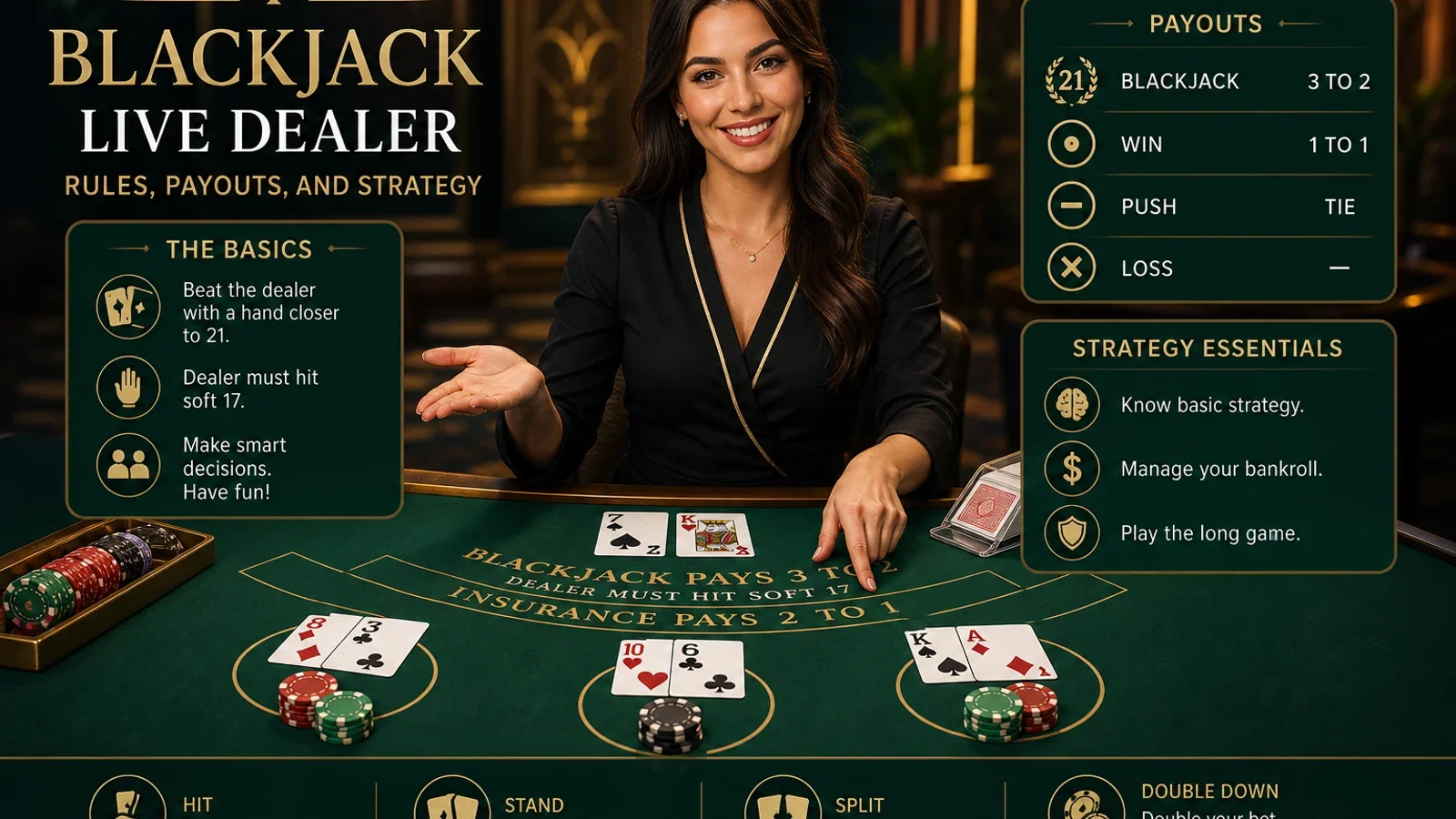
Blackjack is a card game in which you try to beat the dealer without going over 21. In live dealer blackjack, a real dealer handles physical cards while you place bets and make decisions through an online casino’s website or app.
My advice is to spend less time admiring the studio and more time reading the table rules. A sharp video feed does not tell you whether blackjack pays 3:2, whether you can double after splitting, or whether the operator is authorized where you are playing.
Start with lawful access and an affordable wager. Then compare the rules, use a matching basic-strategy chart, and keep a firm spending limit.
Overview: How live dealer blackjack works
Blackjack rules and card values
You play against the dealer, not the other people at the table. You win when your hand finishes higher than the dealer’s without exceeding 21, or when the dealer busts and your hand has not already busted.
- Number cards: Count at face value.
- Jacks, queens, and kings: Count as 10.
- Aces: Count as 1 or 11, whichever keeps the hand from busting.
If you exceed 21, you bust and lose that hand, even if the dealer later busts. Matching eligible totals usually produce a push, which returns your original wager.
A natural blackjack is an ace and a 10-value card in your initial two-card hand. It differs from reaching 21 with three or more cards. A dealer’s natural beats an ordinary 21, and a two-card 21 after splitting generally does not receive the natural-blackjack payout. Check the table’s rules for these distinctions.
Live dealer versus digital blackjack
Live blackjack combines physical cards, a video stream, and software that accepts wagers, displays your options, and settles results. Decisions have deadlines, and you generally wait for the dealer and other participants before the next round.
Digital blackjack, also called RNG blackjack, uses software-generated card outcomes rather than a live dealer. It typically lets you play at your own pace.
I see the choice as atmosphere versus control of the pace. Live play supplies dealer interaction; digital play usually offers less waiting. Neither format excuses skipping the rules, and live video is not proof of lawful access or flawless operation.
Live blackjack table formats
- Seat-based tables: Take an available seat and make decisions for your own hand.
- Bet-behind tables: Wager on another player’s hand. That player controls the decisions, and rules for following splits and doubles vary.
- Shared-hand or unlimited-seat games: Many players join the same round. Some formats allow individual decisions from a common starting hand.
- Special variants: Speed formats, early-payout options, altered decks, fees, and multipliers can change the experience or the mathematics.
Bet-behind would not be my first choice for learning strategy because someone else controls the hand. I would also learn ordinary blackjack before trying a variant with extra features. A familiar name does not guarantee familiar rules.
Check who controls decisions in a shared-hand game. In its June 2020 announcement of Majority Rules Speed Blackjack, Playtech described a mode where players vote on hitting, standing, doubling, or splitting, with a vote of 50% or more triggering the action. Players must decide in advance whether to accept split and double decisions requiring additional money. That differs from choosing every action yourself; the announcement does not establish current availability at a US operator.
Practical guide: Playing and comparing live blackjack
Before your first live hand
- Check authorization. Confirm that the operator may offer online casino games where you will physically play and that you meet its age and account requirements.
- Set your budget. Decide what you can afford to lose before depositing. Use account limits where available.
- Complete account checks. Follow identity-verification and location-check instructions. Do not try to bypass them.
- Read the table rules. Check the blackjack payout, dealer rules, main-bet limits, split and double options, and side-bet paytables.
- Check the controls. Know where to hit, stand, double, and split, and what happens if the decision timer expires.
- Confirm your wager. Make sure you have not accidentally added a side bet before betting closes.
If the minimum feels uncomfortable, choose another table or do not play. A minimum bet is not a recommendation for your budget.
Hit, stand, double, split, surrender, and insurance
| Action | What it means | What to check |
|---|---|---|
| Hit | Take another card. | A total above 21 immediately loses the hand. |
| Stand | Keep your current total. | The dealer completes its hand under fixed rules, not personal judgment. |
| Double down | Add a wager, usually equal to the original bet, and take one final card. | Eligible starting totals and whether doubling after splitting is allowed. |
| Split | Separate an eligible pair into two hands with an additional wager. | Pair eligibility, resplitting limits, and restrictions on split aces. |
| Surrender | Give up an eligible hand and recover half the original wager. | Whether it is offered and when it is permitted. |
| Insurance | Make a separate wager that the dealer has blackjack when showing an ace. | Its price, payout, and settlement rules. It does not insure against every loss. |
A soft hand contains an ace counting as 11. Ace-6, for example, is soft 17. If another card would cause a bust, the ace can count as 1 instead. A hard hand has no ace counting as 11. This flexibility is why strategy charts separate hard and soft totals.
Which blackjack rules matter most?
My table-selection priorities are lawful access, an affordable wager, and favorable rules, in that order. Once the first two are settled, compare:
- Natural-blackjack payout: Prefer 3:2 over 6:5 when the other rules are identical.
- Dealer soft 17: Standing on soft 17 is generally more favorable to the player than hitting it.
- Doubling: Check eligible starting totals and whether doubling after splitting is allowed.
- Splitting: Check resplitting, the number of permitted hands, and restrictions on split aces.
- Surrender: Its availability changes the best decision for some difficult hands.
- Dealer blackjack procedure: Check when the dealer looks for blackjack and what happens to additional split or double wagers.
- Deck composition and fees: Ordinary decks, removed cards, and extra charges are not interchangeable conditions.
3:2 versus 6:5 blackjack payouts
On an illustrative $10.00 wager, a winning natural pays $15.00 in profit at 3:2 or $12.00 at 6:5. Your original wager is returned separately. These examples assume no dealer blackjack and no variant-specific adjustment; they are not forecasts of session winnings.
Connecticut’s live dealer technical specifications, revised December 18, 2025, distinguish 3:2 blackjack labeling from 6:5 table layouts and describe materially different rules for several variants.
The comparison below combines selected published requirements with illustrative payout calculations. It compares rules, not casino performance or games confirmed available in every lobby. Example wagers are assumptions, not reported play results.
Gamboool original analysis
We assembled the comparison below from published information and our calculations. These are selected examples, rather than measured gambling sessions or a representative survey.
| Detail | Published information |
|---|---|
| New Jersey Internet gaming authorization: Official approved-site check | New Jersey’s regulator explicitly says that a site absent from its authorized list is not approved to offer Internet gaming in the state. |
| Pennsylvania interactive gaming authorization: Regulator verification route | Pennsylvania directs players to its operator-directory links to verify regulation, providing a state-specific alternative to relying on a casino’s marketing. |
| New Jersey Internet gaming complaints: Operator complaint before regulator escalation | Players must first complain to the casino and receive a response before filing an Internet dispute with the Division. |
| Connecticut standard live blackjack: 3:2 versus 6:5 payout disclosure | The specifications distinguish standard 3:2 payout labeling from an expressly permitted 6:5 table layout; players should not assume every standard-looking table pays identically. |
| Connecticut live gaming tables: Displayed wager limits | Minimum and maximum wagers must be visible, either on the table or through a digital overlay. The specifications do not establish one universal live-blackjack minimum. |
| Connecticut live gaming paytables: Physical versus interface discrepancy | Paytables must be accessible through the player interface, and a discrepancy between physical and interface paytables must be resolved using the more player-favorable paytable. |
| Connecticut Speed Blackjack: Dealer rule and payout disclosures | The specified Speed Blackjack labeling combines a 3:2 blackjack payout with a dealer-hit-soft-17 rule and a draw-when-ready feature. These specifications are not evidence that a particular operator currently offers the game. |
| Connecticut Power Blackjack: Deck composition differs from standard blackjack | Power Blackjack removes both 9s and 10s, demonstrating why a blackjack variant cannot be evaluated solely by its natural-blackjack payout. |
| Connecticut Fun Fun 21: Variant-specific playing rules | The required labeling includes doubling at any time, player wins on all 21s, dealer hits soft 17, and removal of 10s. These are materially different conditions from ordinary blackjack. |
| Connecticut Bet Stacker Blackjack: Fee-bearing hybrid variant | The specified game combines a 3:2 blackjack payout with a 10% main-bet fee and multipliers on initial cards. A familiar payout label does not mean the game has standard blackjack costs. |
| Connecticut electronic dealing shoes: Restrictions on information and shuffle timing | Electronic shoes may not reveal cards before public disclosure, choose house-advantageous shuffle timing, or disclose the remaining shoe’s count. These are specific regulatory requirements, not a blanket fairness endorsement. |
| Connecticut live blackjack card handling: Physical-card replacement requirement | Blackjack cards have a maximum permitted service life and must be removed sooner for damage, wear, tampering, or a regulator request; a live video feed is only one part of the regulated process. |
| BetMGM Blackjack Pro: Initial-bet limits versus additional hand exposure | The operator’s Blackjack Pro description says that splits, insurance, and doubles can exceed initial-bet maximums. This is a product-specific online blackjack example, not a published minimum or maximum for live dealer tables. |
| Calculation | Result | Takeaway |
|---|---|---|
| Winning natural blackjack profit at 3:2 on an illustrative $10.00 wager | $15.00 of profit, excluding returned stake | Compare this with the same wager at a 6:5 table; the natural-blackjack payout matters even when the tables look similar. |
| Winning natural blackjack profit at 6:5 on an illustrative $10.00 wager | $12.00 of profit, excluding returned stake | For the same winning natural and stake, this payout is less favorable than 3:2; check the posted rule before betting. |
| Winning natural blackjack profit at 3:2 on an illustrative $25.00 wager | $37.50 of profit, excluding returned stake | Use the matching 6:5 example to compare the payout at this stake, without treating a single winning hand as a forecast of session returns. |
| Winning natural blackjack profit at 6:5 on an illustrative $25.00 wager | $30.00 of profit, excluding returned stake | A higher stake does not improve the payout ratio; prefer 3:2 over 6:5 when the other rules are identical. |
| Bet Stacker Blackjack main-bet fee on an illustrative $25.00 wager | $2.50 of main-bet fee | Check for a separate fee as well as the blackjack payout. This fee calculation alone does not establish the variant’s overall value or the effect of its multipliers. |
| Illustrative $5 winning natural at 3:2 | $7.50 profit (original stake excluded) | Use this illustrative amount to plan your budget: $7.50 profit (original stake excluded). |
| Illustrative $5 winning natural at 6:5 | $6.00 profit (original stake excluded) | Use this illustrative amount to plan your budget: $6.00 profit (original stake excluded). |
| Illustrative $10 winning natural at 3:2 | $15.00 profit (original stake excluded) | Use this illustrative amount to plan your budget: $15.00 profit (original stake excluded). |
| Illustrative $10 winning natural at 6:5 | $12.00 profit (original stake excluded) | Use this illustrative amount to plan your budget: $12.00 profit (original stake excluded). |
| Illustrative $25 winning natural at 3:2 | $37.50 profit (original stake excluded) | Use this illustrative amount to plan your budget: $37.50 profit (original stake excluded). |
| Illustrative $25 winning natural at 6:5 | $30.00 profit (original stake excluded) | Use this illustrative amount to plan your budget: $30.00 profit (original stake excluded). |
| Illustrative $100 winning natural at 3:2 | $150.00 profit (original stake excluded) | Use this illustrative amount to plan your budget: $150.00 profit (original stake excluded). |
| Illustrative $100 winning natural at 6:5 | $120.00 profit (original stake excluded) | Use this illustrative amount to plan your budget: $120.00 profit (original stake excluded). |
Research references: njoag.gov, gamingcontrolboard.pa.gov, portal.ct.gov, casino.betmgm.com.
Method: Published inputs collected 2026-10-14. Illustrative assumptions are labeled, and the full calculation inputs remain in the saved research record. These examples support planning; they do not predict a particular session.
I would use the payout comparison to screen otherwise identical ordinary tables, not to rank every game displaying 3:2. Connecticut’s specifications describe Power Blackjack with the 9s and 10s removed, while Fun Fun 21 removes the 10s and includes different playing rules. A standard strategy chart should not be carried over unchanged.
The same document describes Bet Stacker Blackjack with a 10% main-bet fee and multipliers on initial cards. On an illustrative $25.00 main wager, the fee is $2.50. That calculation alone does not establish the game’s overall value because the multiplier rules also matter.
Check the entire game, not just the blackjack payout. These specifications describe required conditions for the named games, not proof that a particular operator currently offers them.
Use basic strategy, not a loss-recovery system
Basic strategy tells you when to hit, stand, double, split, or surrender using your hand, the dealer’s upcard, and the rules. It aims to minimize the casino’s mathematical advantage under those conditions. It does not promise a winning hand or evening.
Choose a chart matching the table’s deck count, soft-17 rule, doubling restrictions, surrender options, and dealer blackjack procedure. Special variants may need their own strategy.
For standard blackjack, useful starting principles include splitting aces and eights, not splitting 10-value cards, and declining insurance under ordinary basic strategy without additional information. These are not substitutes for a complete, rule-matched chart.
I would rather see a player consult the right chart than make a fast decision to look experienced. Have your reference ready before the hand begins, subject to the operator’s rules on assistance, because online decisions have a timer.
Betting systems such as the Martingale do not remove the house edge. Raising wagers after losses can run into your budget or the table maximum. A spending limit is a better plan than trying to force the next hand to repair the last one.
Budget for splits and doubles
Your opening wager is not necessarily your total commitment for the round. Splitting adds another wager, doubling adds money to a hand, and side bets create separate exposure.
For example, BetMGM’s Blackjack Pro description says additional actions such as splits, insurance, and doubles can exceed its initial-bet maximums. This is a digital blackjack example, not a published limit for live tables, but it illustrates the distinction between an initial-bet maximum and a cap on the whole hand.
Choose an opening stake that leaves room for permitted actions without exceeding your limit. If making the correct double would stretch your budget, the starting wager is too large.
Evaluate side bets separately
Side bets may pay for pairs or particular three-card combinations. They have their own probabilities and paytables, and many carry a substantially higher house edge than the main blackjack wager.
Playtech’s September 2016 description of 21+3, for example, uses your first two cards and the dealer’s upcard to form a three-card combination. Its listed winning combinations are a straight, flush, three-of-a-kind, straight flush, or suited three-of-a-kind. The side bet evaluates those cards, not whether your completed blackjack hand beats the dealer. Check your table’s paytable rather than assuming every implementation pays identically.
My preference is to evaluate the main game first. A big advertised side-bet payout is not evidence of better value, and basic strategy on your hand does not make the side bet more likely to win.
Important qualifications for US live blackjack
Online blackjack authorization is state-specific
Real-money online casino gambling is not authorized nationwide. Live blackjack access depends on state law, operator authorization, and the approved games offered in that market. A site accepting registration is not proof of authorization, and a foreign gambling license does not establish US state approval.
Start with your regulator’s operator list rather than casino advertising. New Jersey’s Division of Gaming Enforcement explicitly says sites absent from its authorized list are not approved to offer internet gaming in the state. The Pennsylvania Gaming Control Board’s interactive gaming directory likewise directs players to its links to verify regulation.
Authorization does not guarantee that every listed operator offers live blackjack or your preferred variant. Check the current lobby after confirming the operator’s status.
Where regulated play is available, operators generally require you to be physically within the permitted jurisdiction when wagering. Residency and physical location are different requirements. Follow location checks rather than using location-masking tools to defeat them.
Casino games, sports betting, poker, and social products differ
A sportsbook can be authorized in a state without being allowed to offer blackjack there. Online poker generally involves players competing against one another; blackjack is a casino game against the house. Permission to offer one product does not establish permission to offer another.
Social casinos and sweepstakes-style products require separate consideration. Their currencies, purchase arrangements, prize-redemption terms, and legal treatment differ from those of state-regulated real-money casinos. A blackjack-themed screen does not establish equivalent licensing or player protections.
Physical cards do not replace regulatory oversight
A live stream adds visibility, but it does not guarantee that every part of the service is fair or error-free. Card handling, software, account records, settlement, and complaints procedures still matter.
Connecticut’s specifications illustrate less-visible oversight: they require card-handling controls and restrict electronic shoes from revealing cards prematurely or selecting house-advantageous shuffle timing. These are specific regulatory requirements, not blanket assurances about every live blackjack game.
If a result appears wrong, record the table name, round identifier, time, and disputed amount. Save relevant screenshots and contact the operator through its complaints procedure.
Regulator escalation may be available, but follow the jurisdiction’s process. In New Jersey, players must first complain to the operator and receive its response before filing an internet gaming dispute with the Division of Gaming Enforcement.
Check whether bonuses cover live blackjack
There is no universal rule excluding live blackjack from bonuses. A promotion may exclude it, count its wagers at a reduced rate, or apply only to selected games. Before accepting, check:
- Whether live blackjack is eligible and bonus funds can be used.
- How much each wager contributes toward the wagering requirement.
- Whether the requirement applies to the bonus alone or the deposit and bonus.
- Maximum bets, deadlines, and withdrawal restrictions.
- Restrictions on side bets or particular playing patterns.
I would pass on an unclear offer rather than assume it works with the game I want to play. Do not assume you can move money freely between promotional and cash balances.
Mobile compatibility, timers, and disconnections
Live blackjack may work through an operator’s app, a supported mobile browser, or both. Device compatibility, location permissions, and game availability vary. Check these before depositing.
Read the missed-decision and disconnection rules before wagering. A default action may apply when the timer expires, and an accepted wager may remain active if the video stops. Closing the screen does not necessarily cancel the bet.
If your connection becomes unreliable, stop placing new wagers, check your balance and round history, and contact support about unresolved rounds. A frozen picture does not necessarily mean a voided hand.
Keep a firm stopping point
Good decisions can still lose money. Set deposit and session limits, take breaks, and do not treat blackjack winnings as dependable income.
If you are chasing losses, borrowing to gamble, or repeatedly exceeding your limits, stop and consider a cooling-off period or self-exclusion. These are access-control tools, not ways to make gambling profitable.
Frequently asked questions about live blackjack
Can I play live blackjack on my phone?
Often, yes, if the operator supports your device and offers the game in your permitted location. You may need an app or supported browser, identity verification, and location permissions. A stable connection matters because decisions have deadlines.
What is the minimum live blackjack bet?
There is no universal minimum. Check the current lobby and table rules. Side bets can have separate limits, and splits and doubles can increase your total wager beyond the opening bet.
Is every hand totaling 21 a blackjack?
No. A natural blackjack is an ace and a 10-value card in the initial two-card hand. A 21 made with additional cards normally pays as an ordinary winning hand, not at the natural-blackjack rate.
Should I take insurance or even money?
Ordinary basic strategy generally advises against insurance. In a standard 3:2 game, taking even money on your natural when the dealer shows an ace has the same economic effect as taking insurance. Special payout structures can change that comparison.
Can I count cards in live blackjack?
Card counting depends on information about cards removed from a shoe. Frequent shuffling, limited shoe penetration, and other procedures can make it impractical or ineffective. It is not a dependable promise of profit, and operator terms may restrict particular forms of advantage play or assistance.
Does another player’s bad decision make me lose?
Another player’s action can change the card sequence in an individual round, but it does not reliably help or hurt you over time when unseen cards are unknown. Focus on your own strategy. Bet-behind differs because you wager directly on the hand that player controls.
Can I practice blackjack for free?
Some operators offer demonstrations or non-wagering previews, but seated live play may require a funded account and a real-money bet. Free digital blackjack can help you practice decisions and controls, although its rules may differ from your intended live table.
Are withdrawals immediate after a win?
Not necessarily. A game payout credited to your casino balance differs from a withdrawal to your bank. Withdrawal timing depends on the operator, payment method, account verification, and applicable promotional restrictions. Read the cashier’s terms before depositing.
What should I prioritize when choosing a blackjack table?
Start with an authorized operator, an affordable minimum, and clear rules. Then compare the natural-blackjack payout, dealer soft-17 rule, split and double options, and decision timer. Evaluate fees, side bets, and bonuses separately. I would choose understandable rules over flashy presentation every time.
Related guides
- Live dealer casino guide: Explore the wider live casino category.
- US online casino guide: Understand the broader online casino landscape.