Overview: Check Withdrawals Before Depositing
US gambling payment methods may include bank transfers, debit cards, e-wallets, prepaid accounts, retail cash payments, and affiliated casino cashiers. Availability depends on the state, gambling product, operator, payment provider, and your account.
Getting money into an account is only half the job. Before choosing a payment method, I would check how the money comes back out. A convenient deposit button is not much help if the same method cannot receive a withdrawal.
My starting point: use existing funds, understand the full cost, and choose a workable withdrawal route before depositing. Compare payout eligibility, verification, fees, limits, and the time until money is usable in your bank or wallet, not just deposit speed.
The license matters more than the payment logo
A familiar card or wallet logo does not establish that a gambling site is authorized in your state. Check the exact website or app against your regulator’s approved operators. The New Jersey Division of Gaming Enforcement, for example, says sites absent from its authorized Internet gaming list are not approved to offer Internet gaming in New Jersey.
Authorization is product-specific. Permission to offer sports betting does not automatically include real-money casino games or poker. An offshore license is not a substitute for relevant US state authorization, and payment acceptance does not establish legality or provide the same state-regulator complaint route.
Practical Guide: Compare Gambling Payment Methods
Confirm the live deposit and withdrawal menus before committing money. This comparison explains trade-offs, not guaranteed availability.
| Method | Deposit use | Withdrawal use | What I would check first |
|---|---|---|---|
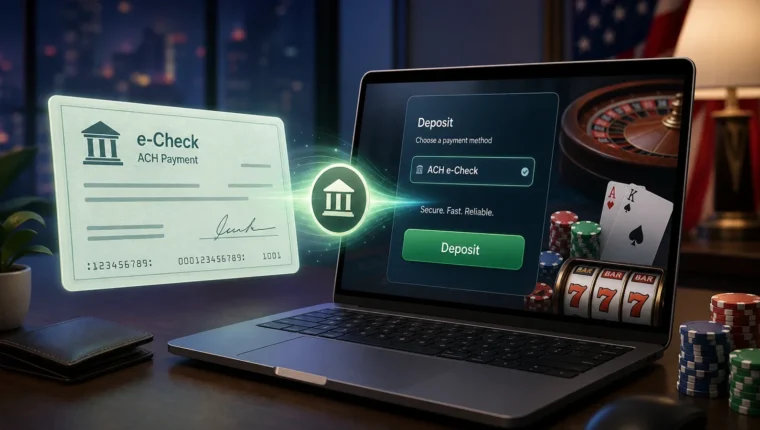
| Online banking or ACH e-check | Bank-funded deposits where supported | May pay to a verified bank account | Settlement, account verification, and provider limits |
| Debit card | Where the operator and issuer permit it | Only where eligible card payouts are offered | Whether your specific card can receive a payout |
| Credit card | Restricted or unavailable in some markets | Do not assume payout support | Borrowing costs and possible cash-advance treatment |
| E-wallet | Through supported services | Subject to verification and any qualifying-deposit rule | The additional transfer from wallet to bank |
| Gambling-linked prepaid account | Through participating programs | May receive payouts under program terms | Loading, ATM, transfer, and inactivity fees |
| Retail cash payment | At participating locations using cashier instructions | A separate payout route is generally needed | Withdrawal arrangements before paying cash |
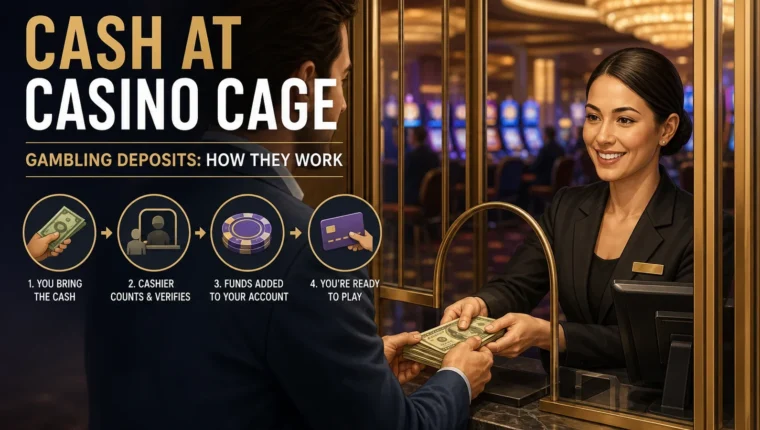
| Affiliated casino cashier | May support in-person funding | May offer approved in-person collection | The designated property and advance approval requirements |
| Bank wire | At some operators | At some operators | Bank fees, minimums, and authenticated instructions |
| Check by mail | Not normally an online funding option | At some operators | Approval, mailing, delivery, and clearance |
Online banking, ACH, and e-checks
If you want money to move between your bank and gambling account without another wallet in the middle, I would compare bank-funded options first. That is a preference for a simpler route, not a claim that bank transfers are always fastest or cheapest.
Online banking, bank transfer, ACH, and e-check labels are not necessarily interchangeable. One service may use a bank authorization screen; another may request account and routing numbers. VIP Preferred is one bank-linked service offered by participating gambling businesses, with its own enrollment and limits.
Available to play does not necessarily mean settled. An operator may credit an ACH deposit before the underlying debit clears. Keep enough money in the funding account until settlement. A returned payment can bring fees, restrictions, or an amount you still owe.
For withdrawals, check bank-account verification and any requirement to deposit through that method first.
Debit cards, credit cards, and gift cards
Debit cards use money in your bank account; credit cards use borrowed money. Either can be restricted by state rules, the operator, the processor, or the issuer. A card network logo does not guarantee your particular card will work.
Deposit acceptance and payout eligibility are separate questions. If your debit card cannot receive withdrawals, arrange another approved destination.
I would avoid credit cards for gambling. Where accepted, a transaction may receive cash-advance treatment, with fees and interest determined by the card agreement. Borrowing adds a financial problem to an activity that already carries a risk of loss.
Ordinary prepaid gift cards differ from gambling-linked prepaid accounts. They may reject gambling transactions, lack payout support, or complicate proof of ownership. Operator-specific gambling gift cards, where offered, also have their own terms.
E-wallets, including PayPal
A supported e-wallet can let you deposit and receive money without entering bank or card details directly into the gambling cashier. PayPal is one example at participating regulated operators; other choices vary.
The detail I would not overlook is the last leg: money in a wallet is not necessarily money in your checking account. A wallet-to-bank transfer can add time and fees.
Both accounts may require verification, and the operator may require a previous wallet deposit before allowing a withdrawal to it. Wallets do not make transactions anonymous or remove account records.
Gambling-linked prepaid accounts, including Play+
Programs such as Play+ may support funding and withdrawals at participating operators. Read the agreement for the particular program rather than assuming one brand’s terms apply everywhere.
Check funding options, card availability, ATM access, outside spending, and loading, transfer, or inactivity charges. Do not assume different operators share the same prepaid account.
A prepaid balance can separate gambling money from household spending, but repeated reloading defeats that purpose. I would pair it with deposit controls rather than treat the card itself as a spending limit.
Retail cash payments and casino cashiers
Participating operators may support cash funding through services such as PayNearMe. Start inside the gambling cashier, obtain the instructions or barcode, and use a location identified for that transaction. Check fees, limits, code expiration, and posting times. Keep the receipt until your account is credited.
Cash in does not automatically mean cash out. Retail cash funding generally requires a separate withdrawal route. That question is especially important if you do not use a bank account.
An affiliated casino cashier may support funding and collection, but the exact property matters. Confirm identification requirements, online-account transaction hours, and any approval needed before arriving. An open cage does not mean every online-account service is immediately available.
Bank wires and mailed checks
Where supported, wires may be useful, but bank fees and minimums can make them unattractive for smaller transactions. Obtain and confirm instructions through the authenticated cashier or official support channel.
A mailed check adds delivery and bank clearance to processing time. Keep your registered address current, and ask your bank about holds. Check-cashing services can add expense and may not accept every check.
How long do gambling withdrawals take?
There is no universal payout time. I would separate three stages:
- Operator review: When is the request approved?
- Payment delivery: When does the provider deliver the funds?
- Usable money: When can you access it at your final destination?
A fast transfer stage does not answer all three. The following comparison assembles selected published policies, not firsthand withdrawal tests or a ranking of actual performance.
Gamboool original analysis
We assembled the comparison below from published information and our calculations. These are selected examples, rather than measured gambling sessions or a representative survey.
| Detail | Published information |
|---|---|
| New Jersey Division of Gaming Enforcement: Internet gaming authorization check | New Jersey explicitly says sites absent from its authorized list are not approved to offer Internet gaming in the state; a payment logo is not the authorization check. |
| New Jersey Internet gaming disputes: Operator complaint required before regulator escalation | Players must first complain to the casino and receive a response before filing an Internet dispute with the Division. |
| FanDuel New Jersey deposits: Payment-source ownership | Deposited money must come from a source legally owned by the player, with a name matching the gambling account. |
| FanDuel New Jersey ACH deposits: Linked bank-account limit | The terms allow no more than three linked ACH accounts at a time. |
| FanDuel New Jersey cage withdrawals: Published processing window | Winnings withdrawals for pickup at the two named cages are processed within two business days. |
| FanDuel New Jersey electronic withdrawals: Published processing window | Debit card, ACH, PayPal/Venmo, and branded prepaid-card winnings withdrawals are processed within three business days; this is not an unconditional bank-availability promise. |
| FanDuel New Jersey check withdrawals: Mailing versus receipt | The published check deadline is mailing within fourteen business days, not delivery or clearance within that period. |
| FanDuel New Jersey unplayed-deposit refunds: Original-method requirement and cash exception | The terms distinguish unplayed-deposit refunds from winnings withdrawals: refunds return through the original method, except cash deposits cannot be refunded under this clause. |
| FanDuel New Jersey transaction charges: Normal charges versus excessive-transaction exceptions | FanDuel says normal deposits and withdrawals incur no operator charge, but excessive transactions may trigger charges with advance contact. |
| FanDuel New Jersey account funds: Interest treatment | The gambling account does not pay interest on held funds. |
| BetMGM casino withdrawal guide: Minimum and prior-deposit requirement | The operator’s general guide states a $20.00 withdrawal minimum and requires a method used for a deposit within the last six months. Confirm applicability in the state-specific cashier. |
| BetMGM casino withdrawal guide: Review precedes payment-provider processing | The guide allows up to five business days for internal approval, followed by the selected payment method’s processing period. |
| BetMGM PayPal versus Visa withdrawals: Published post-approval timing | The guide describes PayPal receipt within 24 hours after approval, versus an additional three to five business days for Visa. These are post-approval windows, not measured end-to-end performance. |
| BetMGM Apple Pay deposits: Browser versus native-app availability | The general guide limits Apple Pay to mobile web browsing in Safari rather than the native app; players should check the live cashier. |
| BetMGM card deposits: Issuer acceptance and external fees | The operator warns that banks may decline online-gaming transactions and that issuer fees may apply independently of operator charges. |
| Calculation | Result | Takeaway |
|---|---|---|
| BetMGM Visa withdrawal planning scenario: full stated review window plus shorter stated delivery window | 8 business days | Budget for review and payment processing separately. This scenario uses the full published review allowance and the shorter Visa processing endpoint; it is not a guaranteed arrival date. |
| BetMGM Visa withdrawal planning scenario: full stated review window plus longer stated delivery window | 10 business days | The longer published Visa processing endpoint adds to the review period. Treat this as a planning scenario, not a promise or an absolute cap on delays. |
| FanDuel New Jersey: difference between electronic and cage withdrawal processing allowances | 1 business days | The designated cages have a shorter published processing allowance, but this comparison does not measure bank delivery, travel time, or actual withdrawal performance. |
Research references: njoag.gov, policies.fanduel.com, casino.betmgm.com.
Method: Published inputs collected 2026-10-14. Illustrative assumptions are labeled, and the full calculation inputs remain in the saved research record. These examples support planning; they do not predict a particular session.
BetMGM: review time comes before payment processing
BetMGM’s casino deposit and withdrawal guide, dated July 30, 2026, describes internal approval taking up to five business days. It describes PayPal receipt within 24 hours after approval and an additional three to five business days for Visa.
Combining the full five-business-day review allowance with the Visa endpoints gives eight- and 10-business-day planning scenarios: five plus three, and five plus five. These estimates are not measured waits, guaranteed arrival dates, or an absolute cap on delays. The PayPal window also begins after approval, not when you submit the request.
The general guide states a $20.00 withdrawal minimum and a requirement to withdraw through a method used for a deposit within the previous six months. Confirm applicability in your state-specific cashier. Check payout eligibility before depositing, rather than opening another payment account after encountering a restriction.
FanDuel New Jersey: processing is not the same as receipt
FanDuel’s New Jersey terms dated August 27, 2026 give designated cage winnings withdrawals a two-business-day processing allowance, versus three business days for listed electronic methods.
That is a one-business-day difference in published processing allowances, not proof that cage pickup delivers usable money faster. Bank delivery, travel, and actual processing are outside that calculation.
The terms describe checks being mailed within 14 business days, not delivered or cleared within that period. They also distinguish winnings withdrawals from refunds of unplayed deposits: those refunds return through the original method, with cash deposits excluded from refunds under that clause.
My takeaway: choose the shortest understandable route to your intended destination, not the most appealing speed label. These examples cover different processing stages and scopes, so they are not an apples-to-apples speed contest.
A withdrawal-first selection checklist
- Confirm eligibility. Check state authorization, age requirements, and physical-location rules for the product.
- Set your budget. Use money you can afford to lose, separate from bills, debt payments, and savings commitments.
- Choose the payout destination. Confirm it is eligible, verified where required, and in your own name.
- Trace every fee. Include operator, bank, wallet, prepaid-program, ATM, and final-transfer charges.
- Read all limits. Check minimums, maximums, rolling provider limits, and your personal deposit cap.
- Separate timing stages. Review deposit posting, withdrawal approval, delivery, and any final bank transfer.
- Check bonus conditions. Payment exclusions and wagering requirements can affect withdrawal eligibility.
For a bank destination, compare supported banking options first. For an existing wallet, examine the whole wallet-to-bank route. For cash funding, arrange the payout route before paying. I would not open an extra financial account merely because a gambling promotion makes it look convenient.
Making a deposit or withdrawal
Sign in through the official app or website, open the cashier, and review the amount and any fee before authorizing a deposit. Use a payment source in your own name, and save the confirmation.
For withdrawals, check the withdrawable balance, not just the displayed total. Unsettled wagers, bonus funds, and uncleared deposits can affect availability. Complete verification, select an eligible destination, and keep the request number.
Weekends, holidays, bank processing, and document requests can affect timing. If you are withdrawing to protect your budget, leave the request alone rather than canceling it to keep playing.
Troubleshooting payment problems
- Declined card: Check details, available funds, issuer restrictions, and cashier limits. Ask the issuer whether it permits the transaction. Do not repeatedly retry or defeat a gambling block.
- Missing deposit: Check its status and processing window. Contact support with the receipt or reference before sending another payment.
- Pending bank transaction: A pending authorization is not necessarily a completed charge. Ask the issuer and operator about its status.
- Unavailable withdrawal method: Check payout support, verification, and any previous-deposit requirement. Ask for an approved alternative.
- Delayed withdrawal: Check document requests and unsettled funds, then request a status update and reference number.
- Reached limit: Identify whether it is a personal, operator, or provider limit. Do not split transactions to evade it.
Keep correspondence and transaction records. For unresolved payout problems, follow the operator’s complaint process and the regulator’s escalation procedure. New Jersey requires an operator complaint and response before an Internet dispute is filed with the Division.
An unauthorized bank transfer is different from a delayed casino payout. The Consumer Financial Protection Bureau’s Regulation E guidance says a financial institution cannot require you to contact the merchant first before investigating a reported unauthorized electronic fund transfer. Report suspected unauthorized transfers promptly to your financial provider. A chargeback is not a way to recover money you knowingly wagered and lost.
Important Qualifications
Casino, poker, sportsbook, and sweepstakes balances differ
Even under one brand, casino games, poker, and sports betting may have different cashiers, balances, promotions, or procedures. Do not assume funds move freely between products or states.
Social casinos generally use virtual currency rather than a conventional real-money gambling balance. Sweepstakes products may have separate promotional currencies, purchase terms, free-entry routes, and prize-redemption conditions. A coin purchase is not automatically a regulated casino deposit, and prize redemption does not necessarily follow casino withdrawal rules.
Check availability and terms for each product. A payment provider’s presence does not establish that a sweepstakes offering is permitted in your state.
Cryptocurrency is not a workaround
Cryptocurrency is not a standard cashier option across state-regulated US online gambling. Acceptance does not establish US authorization, and crypto should not be used to bypass payment restrictions.
Risks include irreversible transfers, wrong addresses or networks, fees, custody failures, and price changes. Stablecoins are not equivalent to insured bank deposits. Transactions are not inherently anonymous, and a wallet does not necessarily keep assets offline.
Security, ownership, and insurance
No payment method makes gambling risk-free. Use unique passwords and multifactor authentication where available. Access payment and document-upload tools through official channels. Do not provide credentials or one-time security codes in response to unsolicited messages.
Operators may request identification, address details, proof of payment-source ownership, or source-of-funds information. Keep details consistent, and do not use someone else’s card or bank account.
Do not assume a casino balance or prepaid program has the same insurance protection as your bank account. Read any insurance provision alongside the actual account agreement and its conditions.
Free deposits can still have costs
No operator fee does not mean no bank, wallet, or prepaid-program fee. FanDuel’s New Jersey terms describe no normal operator deposit or withdrawal charge, but allow excessive-transaction charges with advance contact. External provider charges remain separate.
I would not use a gambling account to park everyday money. FanDuel’s terms, for example, state that held account funds do not earn interest.
Use payment controls before you need them
Set deposit limits before playing. Consider time limits, cooling-off periods, self-exclusion, and bank gambling-transaction blocks where available.
A deposit cap does not necessarily cap total wagering or losses. Separate accounts and prepaid balances can improve recordkeeping, but neither prevents repeated funding. If you feel pressure to borrow, chase losses, or find another route after reaching a limit, stop rather than deposit again.
Frequently Asked Questions
What is the best gambling payment method?
There is no universal best option. Choose a supported method with an eligible withdrawal destination, understandable fees, and workable limits. I would favor a simple route using existing funds over borrowing or opening extra accounts for a promotion.
Do US banks allow online gambling payments?
Some support transactions with lawful, state-regulated operators; others restrict gambling or particular payment types. There is no blanket rule requiring every US bank to decline every gambling transaction. Operator acceptance does not guarantee issuer approval.
Can I use a debit card?
Yes, where the operator offers it and your issuer permits it. Check payout support separately: a deposit-capable card may not receive withdrawals.
Which method has the fastest withdrawals?
There is no universal winner. Eligible card payouts and wallets can have short delivery times after approval, but review and verification still matter. Compare the time until money is usable at your final destination.
Can I withdraw using a different method?
Sometimes. The operator may require a verified original method or offer an approved alternative when that method cannot receive money. Winnings withdrawals and refunds of unplayed deposits may follow different rules.
Why is my displayed balance larger than my withdrawal balance?
Bonus funds, unsettled wagers, and uncleared payments can affect withdrawable funds. Check the balance breakdown and promotion terms, and ask support about anything unclear.
Why is identity verification required for a payout?
Operators check eligibility, ownership, and compliance with applicable requirements. Verification may happen at registration or later. Use official upload channels, and ensure payment details match your gambling account.
Can I deposit from outside the state?
Account-access and funding rules vary. Permission to log in does not necessarily permit deposits or wagering. Follow the product’s location rules, and do not disguise your location.
Can I deposit without a bonus?
Usually, there is a way to play without a promotional offer, but check enrollment settings. Declining a bonus can avoid its wagering conditions, not normal verification and payment rules.
Related Guides
See the US online casino guide for broader regulatory context, or explore these payment guides: